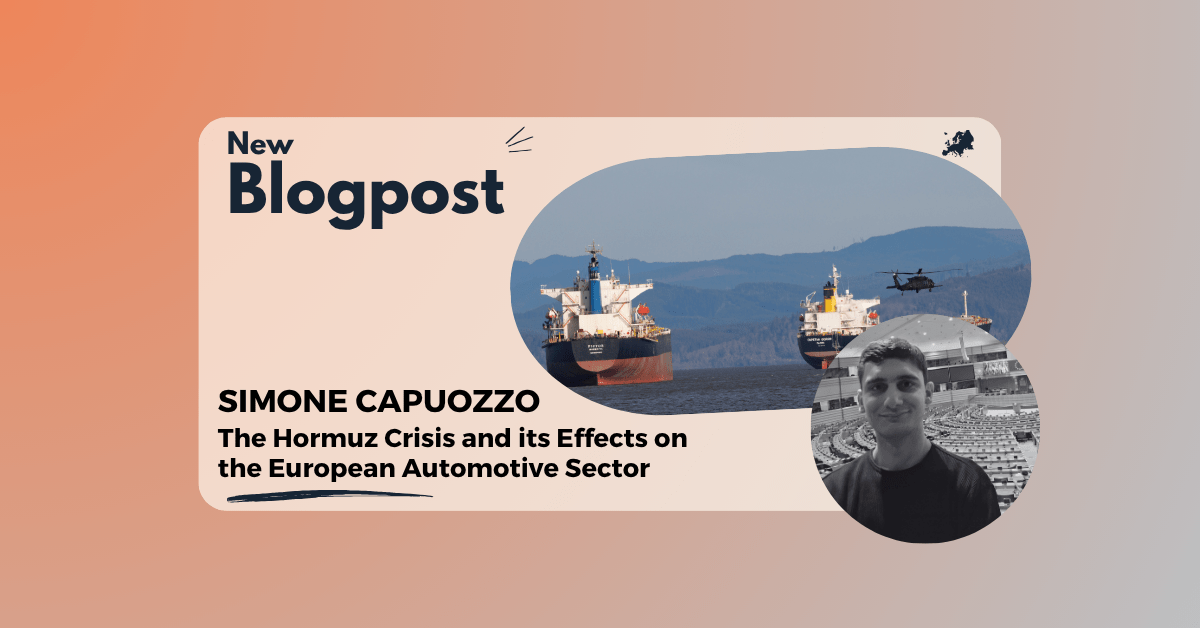
By Simone Capuozzo
The European automotive sector is at a turning point. After years of debating the need for green policies and drafting strategies for their implementation, decarbonisation deadlines are finally approaching. But why are carmakers facing so much pressure? The answer is simple: passenger cars are one of the biggest emitters of greenhouse gases, making a transport revolution essential toward the green transition. Moreover, the automotive sector is usually the one which spearheads national industries, meaning that net-zero progress in carmaking will spill over to other industries. However, European carmakers are experiencing a rough patch. Last year, Volkswagen announced unprecedented layoffs and plant closures, while Stellantis confirmed only a slim return to profitability. All this while Chinese car exports are booming, and the US are imposing 25% tariffs on European cars. If the outlook was already challenging, the Hormuz crisis is bound to inflict even more damage.
Why is the Strait of Hormuz important?
The Strait of Hormuz is currently being used as a major geopolitical leverage by Iran after being attacked by the United States and Israel given their concerns over Iran’s possible development of nuclear weapons. Although the US were hoping for a quick regime change as it happened in Venezuela, the conflict is still ongoing despite theoretical ceasefire agreements. Iran has closed the Strait given its crucial importance towards international trade, hoping to create a significant geopolitical leverage on the US and Israel to end the conflict. In response, the US has installed a blockade of its own, heightening tensions. While Pakistan has announced the reaching of a deal between the belligerents, it is unclear whether peace will hold.
What does this have to do with the European car market?
First, as Iran is one of the major oil producing countries, and the Strait is one of the biggest passages for global petrol shipping, this conflict has led petrol prices upwards. Before the war, on February 23rd, a litre of diesel would have cost €1.594. On April 6th, costs peaked at €2.112, marking an 8% increase. As of June 5th, the average price for a litre of diesel in the EU sits at €1.84372, a price that can still be burdening for commuters and may remain high after the war ends.
Second, automotive production is being disrupted as aluminium producers in the Gulf have cut production, which made prices skyrocket. Incapable of finding alternative suppliers, carmakers are resorting to panic buying, and Stellantis has already admitted it could face over one billion euros in potential 2026 raw materials cost increases. Beyond metal, most vehicles contain several rubber and plastic components that inevitably depend on the availability of oil for their production, adding costs that neither carmakers nor drivers are eager to bear.
The weaponisation of petrol may be the push that electric vehicles have desperately needed in Europe. EVs have thus far struggled in the Old Continent, with drivers citing high prices and limited charging options for keeping their ICE (internal combustion engine) vehicles and at most switching to hybrid cars. Now, European drivers seem convinced to ditch combustion engines. EV sales have increased by 51% in March, led by Nordic countries, with an impressive 91% of new registrations in Norway belonging to EVs. Even in France, Germany, and Italy, homes of flagship carmakers, registrations have increased by roughly 40%.
But how is this crisis impacting European carmakers’ competition with their US and Chinese rivals? Analysing the change in registration in March 2026, short after the start of the hostilities, cars from the Volkswagen Group lost ground to Stellantis but remained the top choices, while BYD and Tesla initially experienced an unusual shrink in sales, picking up the pace again in the following month.
How are policymakers responding to the Hormuz crisis?
With carmakers bracing for impact and drivers looking after their savings, what are policymakers doing to tackle this crisis? For now, some EU governments have cut taxes on fuel, drawing criticism from the Commission and the IMF, who would have preferred interventions aimed at the most affected drivers. The initiative is nonetheless left to the Member States, given the mixed results of the EU-wide intervention on energy prices in 2022. A possible EU-level measure is being considered by the European Central Bank, which, stressing the need for reducing dependencies on fossil fuels, is monitoring inflation and growth to adjust the EU’s monetary policy to yet another energy shock. Another solution is the announced de-escalating and defensive naval mission, led by France and the UK with the participation of other allies, to secure the Strait and allow for safe shipping, once fighting stops. In particular, they will embark on a mine-sweeping operation featuring the French nuclear-powered aircraft carrier Charles de Gaulle and Britain’s HMS Dragon and RFA Lyme Bay destroyers, with the latter using its new anti-mine system. The mission’s intended purpose is to uphold international maritime law while supporting diplomatic channels in the region. Although German Chancellor Friedrich Merz has highlighted the need for solid legal grounds, experts warn that naval missions in the Middle East would not replace diplomatic efforts and may favour Russian operations in European waters. Moreover, this mission is of dubious effectiveness: European vessels would need American air cover for surveillance and protection and, if Iran were to plan a large number of mines, this operation could take several months. A simple naval mission without a well-thought diplomatic and economic strategy will thus likely not be enough to bring stability to energy markets and the automotive sector.
Possible lessons for the future
Overall, the automotive sector seems to be in dire need for securitisation, as it finds itself yet again hostage of events it cannot control. Despite the spectre of a long war looming on international politics, two votes by both chambers of the US Congress to stop the war with Iran showed representatives’ opposition to the conflict, although Trump could always veto an eventual joint resolution. An unprecedented counter-veto is highly unlikely, since it would require a two-thirds majority in both chambers. Nonetheless, however long the energy shock caused by the hostilities may last, decarbonisation seems to have become a shield against coercion rather than a safeguard for the environment. What is certain is that a return to power politics will undermine the peaceful interdependence global trade needs to foster, paving the way to new hardships and grievances. To safeguard its competitiveness in the long term, the EU faces a now-or-never moment toward its strategic autonomy.
About the author
Simone holds a bachelor’s and a master’s in European Studies from Maastricht University. His main interests are the geopolitical implications of the green transition, freedom of expression, and the future of EU enlargement.

