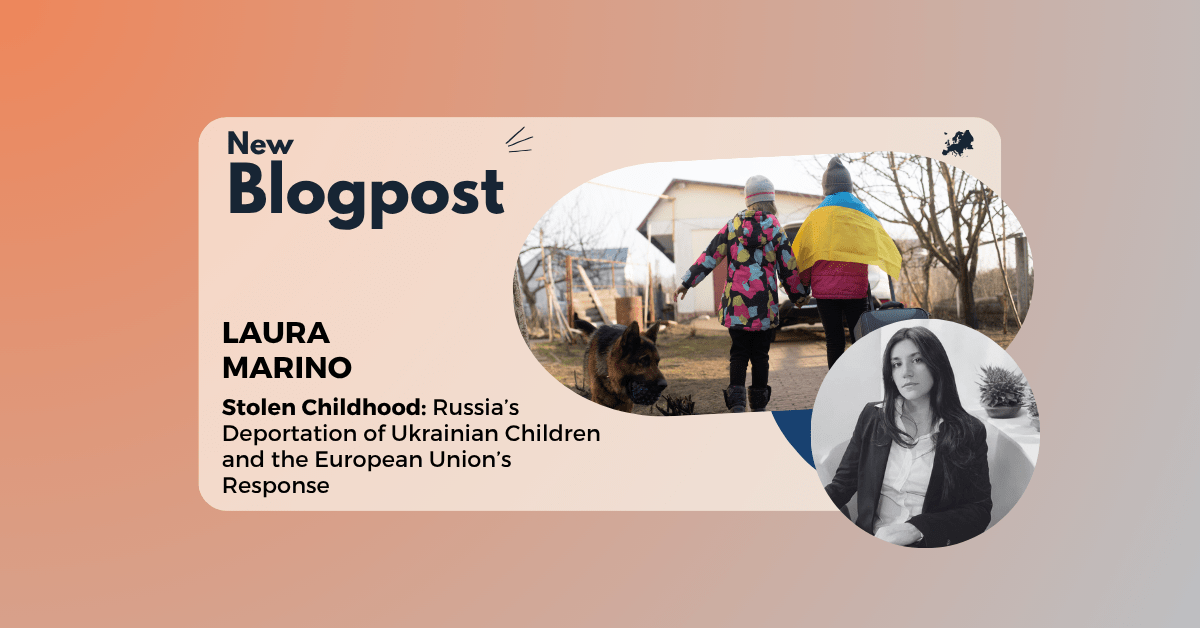
By Laura Marino
In one of the most chilling atrocities of the Russo-Ukrainian War, Russia has abducted nearly 20,000 Ukrainian children, ripping them from their homes, stripping them of their identities, and forcing them into Russian families. Now, they are being russified and indoctrinated with Russian propaganda, while their Ukrainian roots are systematically erased.
The United Nations has condemned these actions as war crimes, and the International Criminal Court (ICC) has issued arrest warrants for Vladimir Putin and Russia’s Children’s Rights Commissioner Maria Lvova.
The systematic deportation of Ukrainian children by Russia represents not just a severe violation of international law, but also a political weapon conceived for dismantling Ukrainian national identity. This article analyzes the scale of the phenomenon and the responsiveness of the international community’s reaction, particularly that of the European
Union (EU).
Russia’s Systematic Abduction and Forced Re-education of Ukrainian Children
Following its invasion of Ukraine, Russia has systematically kidnapped, deported, and forced the adoption of Ukrainian children, primarily from occupied areas in the south and east. During the tumult of the war, children were frequently abducted from orphanages, group homes, or separated from their families. Many of those children are not true orphans but “social orphans” —children whose families are momentarily incapable of taking care of them because of poverty, war, or other circumstances. Furthermore, the ombudsman for children’s rights in Ukraine claims that Russia abducts these children to supplement its own population.
Many of the abducted children were sent to so-called “summer camps” or “re-education camps” in Russia. Although these camps had been promoted as safe places for children to escape the war, they were actually part of a massive brainwashing and indoctrination campaign. Those imprisoned in the camp reported numerous punishments, bullying, and psychological pressure to embrace Russian identity, including singing the Russian national anthem. According to Ukrainian officials, several also experienced inadequate care, verbal abuse, and even sexual exploitation.
International organizations, including the United Nations and Yale’s Humanitarian Research Lab, have documented that Russia is systematically attempting to eradicate Ukrainian identity and forcefully integrate Ukrainians into Russian society —acts that likely constitute war crimes.
Russia’s Legislative and Criminal Strategy
Russia has implemented a coordinated legal and criminal strategy to legitimise and enable the deportation of Ukrainian children. Key individuals involved in this program include Maria Lvova-Belova, Russia’s Commissioner for Children’s Rights, who personally took custody of a Ukrainian child from Mariupol, alongside other senior officials. Together, these figures directed legislative changes and oversaw the forced adoption and naturalisation of Ukrainian children.
In fact, Russian law initially prohibited the adoption of foreign children without their home country’s consent. However, in May 2022, Vladimir Putin signed a decree granting Russian citizenship to Ukrainian children, clearing the way for their permanent adoption by Russian families. This legal change makes future reunification with Ukrainian families or repatriation much more difficult. Russian social service agencies and orphanages are also allowed to apply for the adoption of abducted children, automatically initiating their naturalisation as Russian citizens.
According to experts such as Wayne Jordash from NGO Global Rights Compliance, these acts qualify as war crimes, and, considering their scope and purpose, crimes against humanity. Russia’s criminal aim is confirmed by the forced identity alterations of children and the deliberate attempts to eradicate Ukrainian heritage.
The Legal Framework: How Russia is Violating Children’s Rights
Russia’s forced deportation of Ukrainian children constitutes a direct and serious violation of international law. Due to Russia’s ratification and signature of the Convention on the Rights of the Child, the Committee on the Rights of the Child (CRC) is one of the main legal authorities that monitors these activities. The CRC operates under a treaty that Russia itself agreed to abide by, in contrast to the International Criminal Court (ICC), which Russia has decided to disregard.
International humanitarian law —the rules that govern war— clearly protects children. Except under severe circumstances, such as when their immediate safety is in danger, it states that children cannot be hurt, separated from their family, or forced to be transferred from their nation. Even in such cases, strict guidelines still exist, such as obtaining their parents’ or guardians’ approval.
Additionally, Russia’s actions violate the Convention on the Rights of the Child. This treaty protects every child’s right to their name, nationality, and family. Children should only be separated from their parents through legal procedures that are centered on their best interests, and adoption should be a last resort, done carefully and only when necessary. Russia is circumventing these protections by accelerating adoptions, requiring citizenship changes, and removing children from their families without consent.
Europe’s Response to the Deportation of Ukrainian Children
The European Union has repeatedly called for urgent action to protect and repatriate Ukrainian children deported to Russia and Belarus. The European Parliament has demanded the creation of a humanitarian corridor, mechanisms for family reunification, and the establishment of a special tribunal for war crimes.
Institutions such as the Parliamentary Assembly of the Council of Europe (PACE) noted that over 19,500 Ukrainian children have been reported as deported, with only a few hundred returned. Both EU bodies and PACE stress that children must never be used as political pawns or as war trophies.
Both institutions underline the need for neutral humanitarian access to Russian-controlled areas in order to identify and recover the children. They also emphasise the role of host nations in safeguarding children’s rights by ensuring access to education, healthcare, and mental health support, and preserving their cultural identity to facilitate their eventual return to Ukraine.
Notably, in the broader context, the decision of the United States President Donald Trump’s administration to cut funding of the aforementioned Yale’s Humanitarian Research Lab, one of the few centers involved in the systematic tracking of deported children, opens up a dangerous void in the independent documentation of Russian war crimes. In this context, the EU has both the moral responsibility and the strategic opportunity to fill this vacuum and assume leadership over war crimes research, including investigations on child deportation. This type of action would demonstrate Europe’s stance against the use of war as an instrument of cultural and identity destruction, and reinforce the message that the crime against children, the most vulnerable, will not pass unpunished.
Conclusion
The abduction and forced deportation of Ukrainian children by Russia is not only a violation of international law, but it is also a calculated campaign to erase national identity and assert control through cultural assimilation. Supported by changes in Russian law and promoted by government officials at the highest level, this practice represents a direct assault on the values and the frameworks meant to protect children worldwide. International actors —from the EU and PACE to humanitarian institutions— have a responsibility to respond not just with words, but with coordinated mechanisms for justice, protection, and return. At stake is not only the future of thousands of children, but the credibility of the global community in defending the most fundamental human right in the face of aggression.
About the author
Laura Marino holds a Master’s in Planning and Management of Social Work from the University of Parma, with a thesis on the Ukrainian migration crisis. She has experience in advocacy, research, and fieldwork on migration and human rights, organizing educational programs and social initiatives. Passionate about social inclusion, she has also been actively involved in volunteer projects.
 European Studies Review
One thought on “Stolen Childhood: Russia’s Deportation of Ukrainian Children and the European Response”